Wednesday, 31 July 2013

For Monday
On Ohau Mountain from christchurch military area
trapped by avalanche-weather has stopped any chance of rescue
24 hours time period
2 injured -broken leg and 1 minor injury
Dusk in end of winter
Research
What would be the predicted weather forecast for this time of year/day on Ohau Mountain?
What Gear are they likely to have and how will this help them?
What are the possibilities?
and anything else you can think of...
Draft out a persona for us to collectively discuss on monday Lunch time.
trapped by avalanche-weather has stopped any chance of rescue
24 hours time period
2 injured -broken leg and 1 minor injury
Dusk in end of winter
Research
What would be the predicted weather forecast for this time of year/day on Ohau Mountain?
What Gear are they likely to have and how will this help them?
What are the possibilities?
and anything else you can think of...
Draft out a persona for us to collectively discuss on monday Lunch time.
Monday, 29 July 2013
Airbag survival info
Very interesting information in regard to airbag survival systems. Perhaps not as valuable as first thought.
FROM -http://www.adventure-journal.com/2013/03/the-truth-about-airbags-and-avalanche-survival/
 This winter I noticed a magazine advertisement for an avalanche airbag pack that claimed “a 97 percent success rate in real world conditions.” What the advertisement didn’t mention was that people caught without an avalanche airbag have an 80 to 90 percent success rate. In other words, most people caught in an avalanche will get a cheap lesson; they will either escape off the slab, grab a tree, dig into the bed surface, ride on top of the debris, be saved by a beacon recovery, or just plain get lucky. Most people caught in an avalanche will survive, which is very good news for all of us.
FROM -http://www.adventure-journal.com/2013/03/the-truth-about-airbags-and-avalanche-survival/
This winter I noticed a magazine advertisement for an avalanche airbag pack that claimed “a 97 percent success rate in real world conditions.” What the advertisement didn’t mention was that people caught without an avalanche airbag have an 80 to 90 percent success rate. In other words, most people caught in an avalanche will get a cheap lesson; they will either escape off the slab, grab a tree, dig into the bed surface, ride on top of the debris, be saved by a beacon recovery, or just plain get lucky. Most people caught in an avalanche will survive, which is very good news for all of us.
It reminds me of the example my college statistics professor presented in which Sanka advertised their decaf coffee as “97 percent caffeine free.” What they didn’t tell you was that regular coffee is 90 percent caffeine free. This, no doubt, sells much more coffee than saying that their decaf coffee has one-third the caffeine as regular coffee, which is much less misleading.
There seems to be no end of confusion about the effectiveness of avalanche airbags. I have heard survival numbers ranging from 97 percent to 3 percent. (“Avalanche airbags would save only 3 out of 100 who would have otherwise have died,” said a prominent avalanche professional in a national class.) That’s a wide range of disagreement.
Today, I want to explain why the numbers vary so dramatically and provide what I think is a more useful — and less misleading — sound bite when we talk about the effectiveness of avalanche airbags.
Most airbag data come from Europe because avalanche airbags were developed there and over the past 15 years they have become ubiquitous. There have been close to 400 documented cases of people getting caught with avalanche airbags (the exact amount is uncertain because many non-fatal cases likely go unreported).
The “97 percent success rate” comes from a database maintained by the Swiss Federal Institute of Snow and Avalanche Research (SLF). In collaboration with ABS brand of avalanche airbags, SLF kept track of all the people that reported being caught in an avalanche with an avalanche airbag, whether they successfully deployed it or not, until the fall of 2010. After that, the responsibility for collecting data was passed to national avalanche centers.
According to a 2007 study of this dataset, the percentage of people caught who died in an avalanche decreased from 19 percent to 3 percent for those who successfully deployed an avalanche airbag. In other words, there is an 81 percent “success rate” for those without a deployed airbag and a 97 percent “success rate” for those who did.
Thus, many people have latched onto the 97 percent figure. But we have to remember that this is 97 percent of those caught. Because most of people caught survive anyway, the number most of us are probably more interested in is what percentage would survive who would have otherwise been killed. (In statistics-speak, this is the difference between “absolute reduction in mortality” and “relative reduction in mortality.” Back to the Sanka coffee example, this is the difference between being “97 percent caffeine free” and “one-third the caffeine of regular coffee.”)
At the International Snow Science Workshop last fall, the well-respected Canadian researcher, Pascal Haegeli presented some preliminary results of his more up-to-date study on the effectiveness of avalanche airbag packs. He performed the study like standard medical research in which he compared the mortality rate of the treatment group with the control group (people who wore airbags vs. those who did not). As I mentioned before, there is a wide variety in the severity of the avalanche that can catch people. So he only included the cases where people were “seriously involved,” meaning that the avalanche airbag “had a chance to be effective.” In addition, he only included cases with multiple victims in which — in the same avalanche — some wore airbags and some did not, and he also included cases where people failed to deploy the airbag. In other words, he wanted to fairly compare the success of the technology, warts and all. He still needs to add more data from Europe and publish it in a peer-reviewed journal, so I can’t present the numbers here, but his preliminary results suggest the following:
If you look at it optimistically, a deployed airbag saved about half of those who would have otherwise died. If you look pessimistically, you would say that half of the people who deployed airbags died anyway.
Not all people who wore airbags were able to deploy them. If you include these cases, wearing an avalanche airbag saved about a third of those who would otherwise have died.
Pascal was careful to mention that his study presented perhaps a worst-case scenario because, he eliminated less serious avalanches from the analysis and included only multiple burial incidents, and thus the data was biased towards larger, less survivable avalanches.
Indeed, in the April 2012 issue of the Avalanche Review, Jonathan Shefftz did a great summary of five different published data sets, mostly from older European data, and he found roughly similar numbers. Wearing an avalanche airbag would have saved from 35 to 81 people out of 100 who would have otherwise died. (The average of the five studies is 64.) So, it seems that in real-world experience, wearing an avalanche airbag will possibly save a little more than half of those who would have otherwise died.
From my perspective, preventing half of avalanche fatalities is pretty darn good. Avalanche airbags are the best technology we have seen, including the beacon. Although it’s impossible to directly compare beacons with avalanche airbags because they do dramatically different things, most experts agree that the avalanche airbag will likely save more lives.
My pet peeve with this issue is that people who argue about the numbers often leave the most important part out of the discussion – terrain. If you are caught in un-survivable terrain, by definition you won’t survive no matter what kind of rescue gear you use. There have been a number of prominent accidents in which the victim with a deployed airbag died because he was either strained through thick trees and rocks, deposited in a terrain trap, buried deeply, or went over a cliff. In zero-tolerance terrain, airbags don’t work, beacons don’t work, Avalungs don’t work. Nothing works. Save your money, buy a life insurance policy, and use a RECCO so rescuers don’t have to spend all night probing.
So at least for me, unless I’m 99.9 percent certain that the slope won’t slide, I don’t go to un-survivable terrain. If I’m going to spend the money and carry the extra weight of an avalanche airbag pack, I want to ride in terrain where it has a chance to make a difference. In other words, you should choose terrain with no obstacles, no terrain traps or sharp transitions, and avoid large avalanche paths.
The other part of the situation is the often-overlooked issue of what we call “risk homeostasis.” Each gizmo we acquire to increase our safety usually causes us to increase our level of risk at the same time. For instance, when we added seat belts and airbags to cars, fatalities decreased, but they also led us to drive faster, farther, crazier, and talk on our mobile phones at the same time. So safety measures usually work but not nearly as well as we would hope because people just increase their risk (and “utility”) at the same time. In avalanche airbag case, we will also get more powder, more fun, and more risk in the bargain.
The bottom line? Ignore the numbers and focus on terrain and appropriate decision making. My best guess is that avalanche airbag packs will probably save a little more than half of those who would have otherwise have died in an avalanche. They will never save all of them because one out of four will likely die from trauma of hitting trees and rocks on the way down and an additional one out of four will probably end up in a terrain trap (deep burial), buried by a secondary avalanche, or caught in an avalanche that does not travel far enough for the inverse segregation process to work (larger objects rise to the surface).
In addition, people will increase their exposure to risk because of the perception of increased safety, which will cancel out some, but not all, of the effectiveness of avalanche airbags.
As usual, our choice of terrain is far more important than rescue gear. Un-survivable terrain will always be un-survivable. In terrain with few obstacles, terrain traps, sharp transitions and smaller paths, avalanche airbags have the potential to save significantly more than half of those who would have otherwise died. And that sounds pretty good to me.
Bruce Tremper is the director of the U.S. Forest Service Utah Avalanche Center. If you have had an experience with an avalanche and airbag, you can (and should) report it here. To learn more about staying safe in avalanche country, visit the UAC ‘s tutorials.
Photo by Shutterstock
More Avalanche Survivability information (older)
This is the older suitability information that the Canadian study posted previously addresses. However even though the statistics are no longer deemed accurate I believe that the 'Phase' study is still relevant to us.
http://pistehors.com/backcountry/wiki/Avalanches/Avalanche-Survival-Curve
Avalanche Survival Curve
Avalanches > Search and Rescue > Avalanche Survival Curve
Researchers using data gathered by the Swiss Avalanche Research Center at Davos for accidents between 1981 and 1991 have plotted the survival probability of a victim buried under snow against time. This figures show that of 123 skiers dug out of an avalanche during the first 15 minutes of burial only 8 were dead with 6 having sustained injuries as a result of the avalanche itself.
This figure was quite surprising for researchers, despite advances in medicine and search and rescue such as the widespread introduction of Recco equipment the death rate from avalanches remains fairly constant at around 25-30 per year in France or around 60% of victims on extraction. This is largely due to the average response time of the search and rescue services which is 45 minutes in France. This is the time to process the emergency call, warm the motor of a helicopter, fly to and locate the scene of the accident then deploy the search and rescue services. Two thirds of avalanche victims will succumb in that critical half hour.

Avalanche Survival Curve
French Rescue Services Phone Numbers
The FFME (French Mountaineering Federation) maintains a list of phone numbers for the Mountain Police (PGHM) and CRS. This is quicker than passing through the international emergency number (112). You will need to give your location and the number of victims when you call.
The Four Phases of the Avalanche Survival Curve
Survival Phase
In the first 15 minutes 93% of avalanche victims are still alive, indeed most of the deaths occur during the fall either by hitting rocks or trees or being carried over cliffs or by being crushed or suffocated by the weight of snow. Wet snow avalanches, characteristic of spring, are most likely to suffocate or crush skiers during this phase but it is less common for skiers to be caught these.
Asphyxiation Phase
In this half hour period, two thirds of victims will die from asphyxiation. Apart from wet snow avalanches the snow encasing victims contains a significant amount of oxygen and is permeable. If a victim has protected or can clear airways and can breath (that is the weight of snow is not compressing the lungs or thorax) they can usually breath. During this period the surrounding air will either be exhausted or the victims respiration will condense and freeze slowly rendering the surrounding snow impermeable.
Waiting Phase
Between 45 minutes and rescue the victim will probably have found an air pocket and is in a phase of relative security which will allow them to survive for a considerable period. Death is either from slow asphyxia or hypothermia. With an adequate air supply hypothermia is slowed down.
Rescue Phase
Between being rescued and arrival and recovering in hospital the risk of hypothermia is great. Hypothermia begins when the body temperature drops below 35 C (body temperature is around 37C) and it is extremely rare for a victim to survive once their body temperature drops to 29C. The survival phase is critical, when the body is cooled it will divert blood from the extremities to the vital organs, when the body is warmed blood will return to the extremities but at too low a temperature this will cool the vital organs causing death by thermal shock.
In an off-piste accident in the Sept Laux ski station on the 27/01/2001 two victims were rescued during this period by the emergency services but succumbed later in Grenoble hospital.
Conclusion
The basic message is that to survive an avalanche you have to be rescued within 15 minutes, with half an hour to wait before the rescue services arrive on the scene this comes down to your friends. Your life depends on carrying and being proficient in the use of avalanche transceivers and having snow probes and shovels. In ideal conditions it will take around 5 minutes to locate a victim with a transceiver and 10 to 15 minutes to dig them out from the average depth of burial which is 1 meter.
However these figures shouldn't create a false sense of security. In an exercise the author performed with the large Davos rescue services it took 45 minutes to locate and find 5 victims in an avalanche site using transceivers, dogs and probes. If you follow the rules you should never have more than 1 person caught in an avalanche but you may have to climb back up to rescue them which will waste precious minutes and energy.
Avalanche Survivability
sourced from http://www.earnyourturns.com/9079/avalanche-survival-time-reduced/
Canadian Study reduces Avalanche Survival Time
An updated study of avalanche survival curve , spearheaded by Dr. Pascal Haegeli—an avalanche researcher in Vancouver, British Columbia—and published in relative obscurity in the Canadian Medical Association Journal last year indicate that completely buried avalanche victims die significantly more quickly than previously thought, at least in Canada compared to Switzerland.
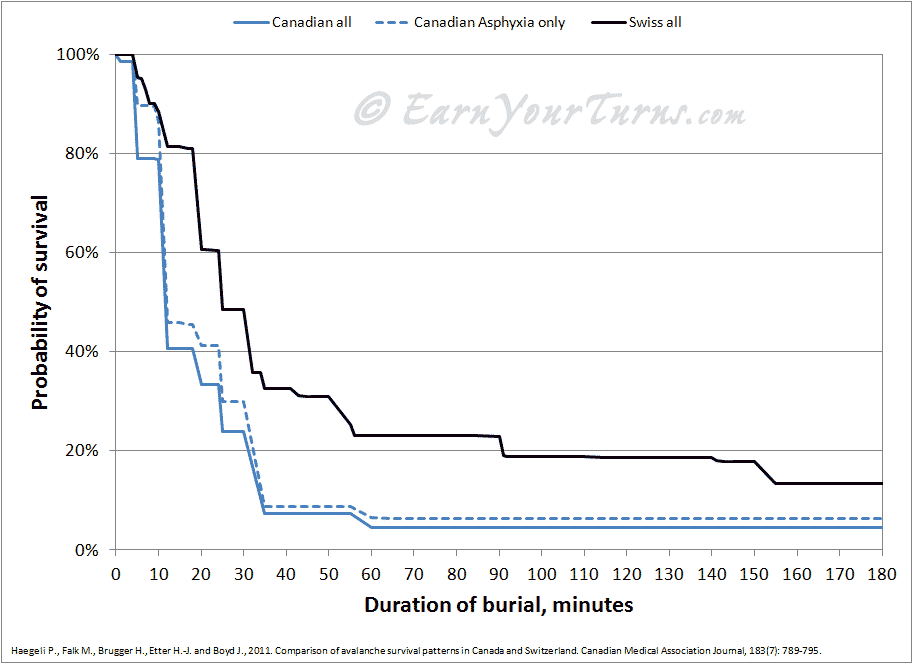
Fig. 1 - Avalanche Survival Curves:
Canadian (blue) VS Swiss (blk)
Canadian dashed lines are for asphyxia only deaths.
Canadian (blue) VS Swiss (blk)
Canadian dashed lines are for asphyxia only deaths.
Finally Pascal Haegeli decided to put the speculation to rest and the results are sobering. The commonly accepted survival phase for burial in an avalanche is about 18 minutes long based on Brugger and Falks analysis of 946 Swiss avalanche fatalities from 1980 to 2005. This more recent study of 301 fatalities in Canada suggests 10 minutes would be a more appropriate guideline, almost half the reigning mindset.
According to this study, if you’re buried in an avalanche in Canada your chances of survival drop precipitously to only 79% after a mere five minutes where they hold until 10 minutes out, then continue falling into the abyss of eternity. By the time 15 minutes have passed, only 40% survive, and there isn’t much life left after that. If you look at the curves, you can see that the Swiss and Canadian survival curves differ in three main aspects:
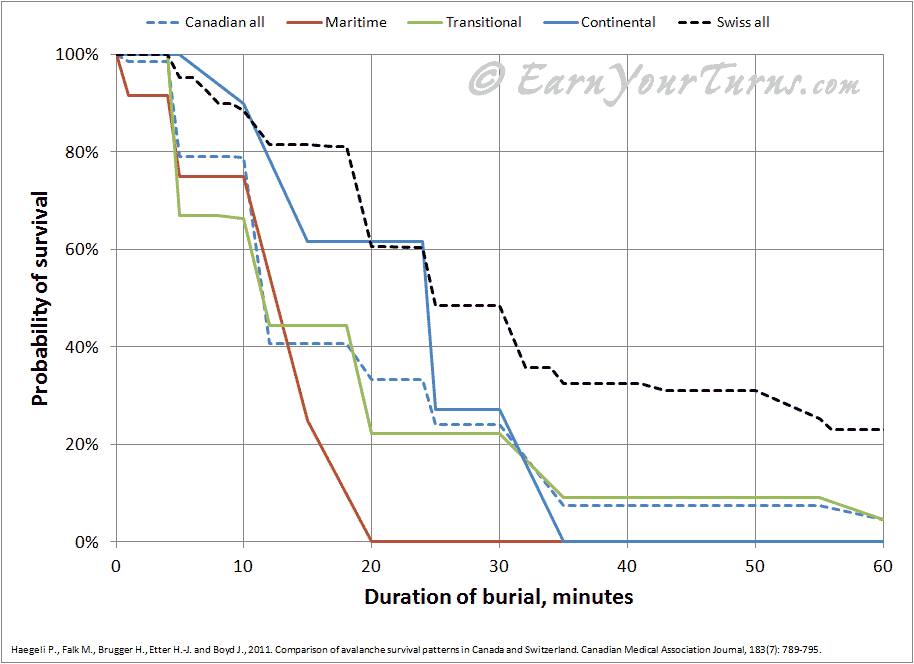
Fig. 2 Zooming in on the first hour of burial - Canadian survival curves by climate.
- The Canadian curve seems to drop immediately from the start. This difference might be associated with the higher rate of trauma among Canadian avalanche fatalities as shown by the study of Boyd et al. (2009), which was also published in CMAJ. You can actually show this by removing the trauma fatalities from the Canadian dataset and calculating an ‘asphyxia-only’ curve. In Fig. 2, the Swiss and the Canadian asphyxia-only’ curves are quite similar in the first 10 minutes. So victims who do not have serious traumatic injuries have about the same chances of survival in the first ten minutes of burial.
- The main drop in the survival curve, which is associated with the onset of asphyxia, seems to occur significantly earlier in the Canadian dataset. This study shows that the more maritime the snow climate, the earlier the onset of asphyxia. When you look only at this port of the survival curve, you see that the Canadian curve from the Rockies looks actually quite similar to the Swiss curve. On the other side the Coast mountain curve (maritime) drops much earlier and the curve from the Columbia mountains (transitional) is in between.
- When you look at the long-term survival of avalanche victims (60 min and longer) you can see that the survival changes in Canada are much lower than in Switzerland. We do not have any data about this, but we suspect that the remoteness of the Canadian mountains might at least part of the reason. In Switzerland, it is possible to have advanced life support at the accident site much more quickly and the time it take to transport the victim to an advanced medical facility is much shorter. So in addition to the conditions in the avalanche, the medical support you get once the victim is extricated also matters much.

Fig. 3 Survival Curves by Climate.
And if you happen to get buried in a moist, maritime snowpack, by 20 minutes you’re as good as dead.
Overall survivability is about the same for either country; 46.2% in Canada versus 46.9% in Switzerland. However, survivability over time drops faster in Canada than Switzerland. The equality in overall survival is attributed to faster extrication times in Canada due to companion rescue efforts. The 10 minute guideline means avoiding getting caught, or buried, through the use of airbag packs or other survival strategies. In the event people are caught and buried, efficient shoveling techniques are essential for survival.
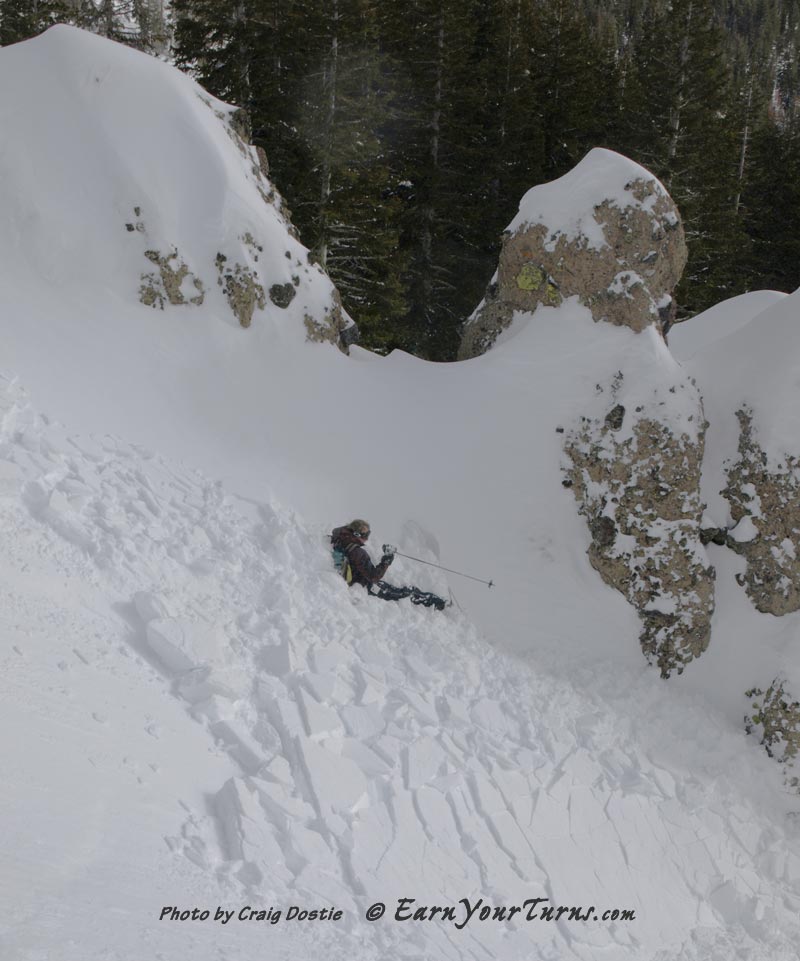
Russ H gets caught trusting a friends recommendation that "it's safe."
Within the dataset analyzed for Hagaeli’s study, only 18.9% of Canadian avalanche deaths were due to trauma, the rest to asphyxia. Pascal Hageali suspects part of the reason for the lower trauma numbers is because not all trauma related incidents had good burial time information recorded.
This study did more than just tabulate overall survival rates for avalanche victims, it also broke out the differences in survival rates for maritime, transitional, and continental snowpacks. Not surprisingly the survival rate was the lowest in a maritime snowpack (41.7%) versus continental (43.6%) or transitional (50.8%). Surprisingly the trauma rate in maritime was only 5% and the average burial depth one meter (the sample size for maritime snowpack incidents was small enough to make this a suspicious number). The same average depth was noticed for a transitional snowpack, but the incidence of trauma increased to 30%. In a continental snowpack trauma accounted for 9.6% of deaths, but the average burial depth was deeper, 1.5 meters. There was also a higher incidence of snowmobile deaths (27.7%) in a continental snowpack compared to a transitional (19.7%) or maritime (11.1%) snowpack.
If that all seems like a lot to digest in such a short space, it is.
The bottom line is much like the rule of climbing with crampons – don’t fall, or in the case of avalanches – don’t get caught.
Take an avalanche course to learn as much as you can to 1) avoid getting caught, 2) know how to avoid getting buried if caught (use an airbag pack, jettison your board(s)), and 3) know how to search and dig so you can unbury a friend fast enough to save them if they are caught, and if you’re the one buried, how to survive long enough until they dig down to you (use an AvaLung).
Ski hard, play fair, and come back home.
Link to full article in CMAJ, March 2011 here.
Patterns of death among avalanche fatalities (Boyd et al, 2009)
Mountaineering and Avalanches
Some really interesting statistics in respect to mountaineering accidents in the US sourced from http://www.stephabegg.com/home/projects/accidentstats.
It is interesting to know that avalanches only account to 3.3% of all mountaineering accidents. From this information perhaps it is not the best focus area/ persona/demographic for us.


It is interesting to know that avalanches only account to 3.3% of all mountaineering accidents. From this information perhaps it is not the best focus area/ persona/demographic for us.
Avalanche Prevention
http://recycled-newz.blogspot.co.nz/2008/03/man-vs-mountain-avalanche-prevention.html
http://abs-airbag.de/us/avalanche/avalanche-tips/
http://www.skiweekend.com/sidecutandrocker/avalanche-airbags/
http://abs-airbag.de/us/avalanche/avalanche-tips/
http://www.skiweekend.com/sidecutandrocker/avalanche-airbags/
Sunday, 28 July 2013
Survival Research
http://science.howstuffworks.com/nature/natural-disasters/avalanche5.htm- interesting information on survival guides (bit more explant)
http://jama.jamanetwork.com/article.aspx?articleid=192649- Article on airpockets
http://users.south-tyrolean.net/avalanche/e/ski04_e.html- Step by step guides to avalanche survival and assitance
http://survival.about.com/od/10/a/Avalanche-Survival-Know-The-Avalanche-Triangle.htm- Very informative about how to spot avalanche
http://climbing.about.com/od/staysafeclimbing/a/Three-Types-Of-Hazardous-Avalanche-Terrain.htmhttp://climbing.about.com/od/staysafeclimbing/a/Three-Types-Of-Hazardous-Avalanche-Terrain.htm- types of avalanche terrain
http://jama.jamanetwork.com/article.aspx?articleid=192649- Article on airpockets
http://users.south-tyrolean.net/avalanche/e/ski04_e.html- Step by step guides to avalanche survival and assitance
http://survival.about.com/od/10/a/Avalanche-Survival-Know-The-Avalanche-Triangle.htm- Very informative about how to spot avalanche
http://climbing.about.com/od/staysafeclimbing/a/Three-Types-Of-Hazardous-Avalanche-Terrain.htmhttp://climbing.about.com/od/staysafeclimbing/a/Three-Types-Of-Hazardous-Avalanche-Terrain.htm- types of avalanche terrain
Potential Senario
These are all the different course run by http://www.aspiringguides.com/
If we are looking into who might be on the mountain or organization who would be responsible for people on the mountain could look into doing a senario based around one of these course and persona's of who might be on them and what there roles would be thought it would be a good idea of a clear defining circumstance in which we could cater to. we could also ask them about what they would do in a avalanche and if they see any gap or piece of equipment they already have that could have a dual function.
CLIMB: instruction courses
- Mountain Skills introduction to mountaineering
- Winter Waterfall ice introductory - based from private hut
- Mt Aspiring Expedition advanced - climb Mt Aspiring
- Steep Alpine Ice intermediate-advanced - base at Pioneer hut
- Private Instruction all levels from 2-4 climbers
- Summit Week all levels from 1-2 climbers
- Darran Mountains climbing week advanced 1 -2 climbers
- One day Sharpen UP program
CLIMB: classic ascents in New Zealand
- Mt Aspiring 5 days - climb the Mattherhorn of the South
- Summit to Sea glacier ascent/descent - 8 days
- Mt Brewster 4 days
- Four day climbing expeditons -- (The Footstool, Mt Sealy, Earnslaw, Barth, Dixon, Minarets, Lendenfeld, Barff)
- Mt Tasman 6 days
- Grade 5 alpine ice - Douglas Peak & Mt Hicks
- Aoraki/Mt Cook - Linda glacier or Hooker Valley route
- Summit Week - intensive 1:1 or 1:2
- COMBO - Mt Aspiring and Aoraki-Cook
- Private Guiding
WILD WALKS: Mt Aspiring National Park (2-8 day wilderness hikes)
- Upper Wilkin Experience - easy, moderate
- Mt Aspiring Discovery - easy, moderate
- Gillespie Pass - moderate/hard
- Rabbit Pass - hard
- Gillespie Pass / Rabbit Pass traverse - hard
- Mt Aspiring Glacier trek - moderate, hard
- Cascade Saddle Assisted Trek
- Darran Mountains climbing week - hard
SKI: ski touring and backcountry snowboard tours and courses
- Pisa Range Tour - 3 days - all levels
- Treble Cone Backcountry - 1 day - strong intermediate
- Private Day Tour - 1 day - all levels
- Black Peak Tour - 3 days - strong intermediate, adv
- Backcountry Awareness Course - 4 days - strong intermediate
- Summit to Sea Tour - 5 day, strong intermediate, adv
Quick Facts about avalanches
Avalanches usually form when changes in the surface of the snow occur. When the snow shifts even just slightly it will start a chain reaction and the snow will slide down a mountain side.-http://www.ussartf.org/avalanches.htm
Avalanches can happened for a few reasons. They can happen from loud noises or from people walking around on the loose snow. You should always be careful not to make loud noises.-http://www.ask.com/question/how-do-avalanches-happen
Avalanches are disastrous natural forces, made of swiftly flowing snow, ice, and rock that guarantee annihilation for any human settlements in their way. They are caused by atypical precipitation, glacier debris or any form of external stress on compact snow
Read more at http://www.environmentalgraffiti.com/mountains/news-10-worst-avalanches-history?image=0#2yvqcKQ35wkwSzEG.99 - the steeper the mountain the faster the velocity of the avalanche.
Avalanches can happened for a few reasons. They can happen from loud noises or from people walking around on the loose snow. You should always be careful not to make loud noises.-http://www.ask.com/question/how-do-avalanches-happen
Avalanches are disastrous natural forces, made of swiftly flowing snow, ice, and rock that guarantee annihilation for any human settlements in their way. They are caused by atypical precipitation, glacier debris or any form of external stress on compact snow
Read more at http://www.environmentalgraffiti.com/mountains/news-10-worst-avalanches-history?image=0#2yvqcKQ35wkwSzEG.99 - the steeper the mountain the faster the velocity of the avalanche.
People Harmed by Avalanches
http://www.environmentalgraffiti.com/mountains/news-10-worst-avalanches-history?image=0
This site has some quick slide show of the 10 worst avalanches- most are not in nz. but its crazy how many people have died.
http://online.wsj.com/article/SB10001424127887323735604578436962699379062.html
article of a rencent avalanche that killed 5 people in the rockies. The people killed were all experienced mountaineers and knew about avalanche safety training
http://www.sunrockice.com/docs/NZ%20avalanche%20fatalities%202004.pdf- article relating to nz fatalities
http://www.stuff.co.nz/national/2754903/Another-avalanche-death-in-the-Alps
http://www.mountainsafety.org.nz/assets/images/AvalInAccReport2000(1).pdf-nz safety report see if can find a more update version
This site has some quick slide show of the 10 worst avalanches- most are not in nz. but its crazy how many people have died.
http://online.wsj.com/article/SB10001424127887323735604578436962699379062.html
article of a rencent avalanche that killed 5 people in the rockies. The people killed were all experienced mountaineers and knew about avalanche safety training
http://www.sunrockice.com/docs/NZ%20avalanche%20fatalities%202004.pdf- article relating to nz fatalities
http://www.stuff.co.nz/national/2754903/Another-avalanche-death-in-the-Alps
http://www.mountainsafety.org.nz/assets/images/AvalInAccReport2000(1).pdf-nz safety report see if can find a more update version
You tube
Here are some you tube clips of large avalanches that have been set off, gives an idea of scale. Also in one someone is skiing on the avalanche, does anyone know if this is a thing only been able to find a few examples.
Subscribe to:
Posts (Atom)